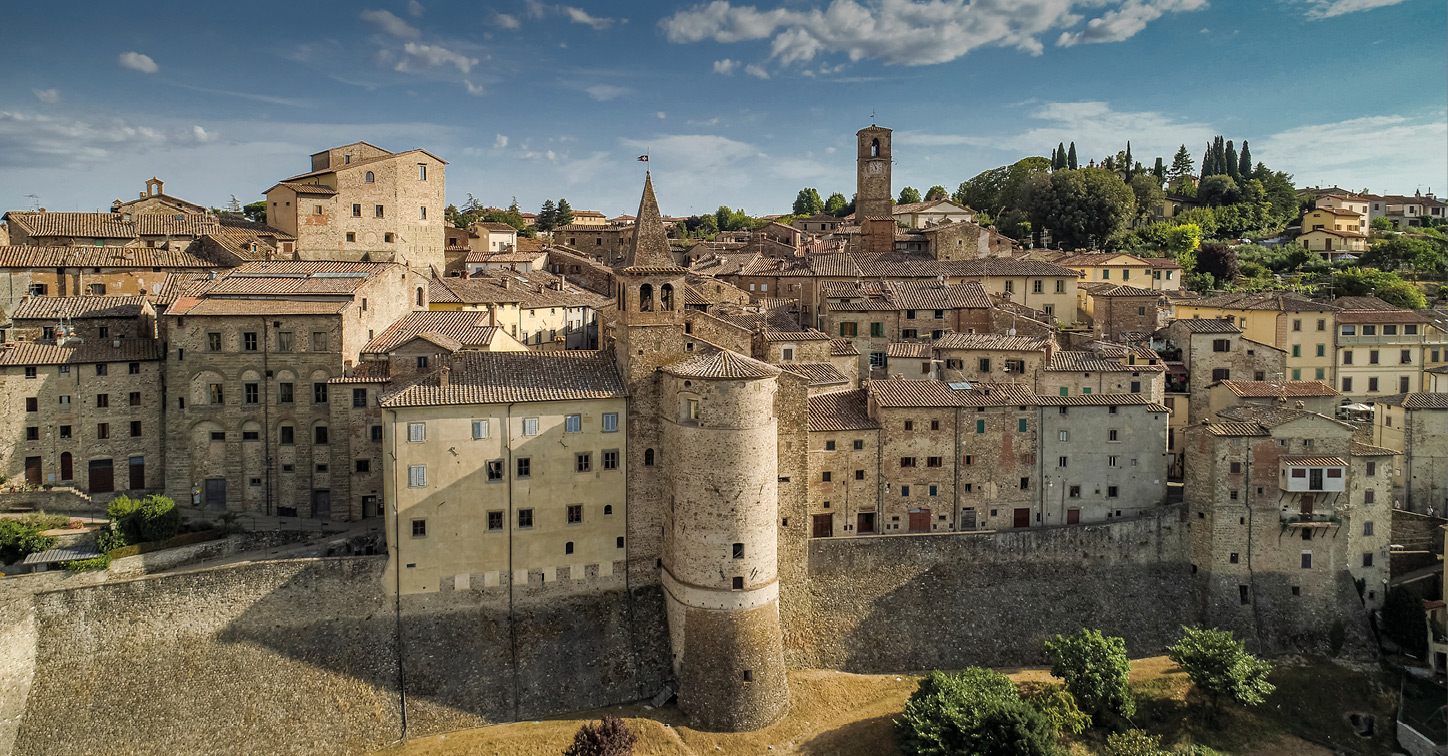
Castello di Laterina, Valdarno, Tuscany
Fourteen places to discover around Laterina, from the nearest hamlet to the great art cities, from the mountains of the Pratomagno to the hills of Chianti. Tap a point on the map to find out more.
In order of distance from Laterina. Tap a name to read.
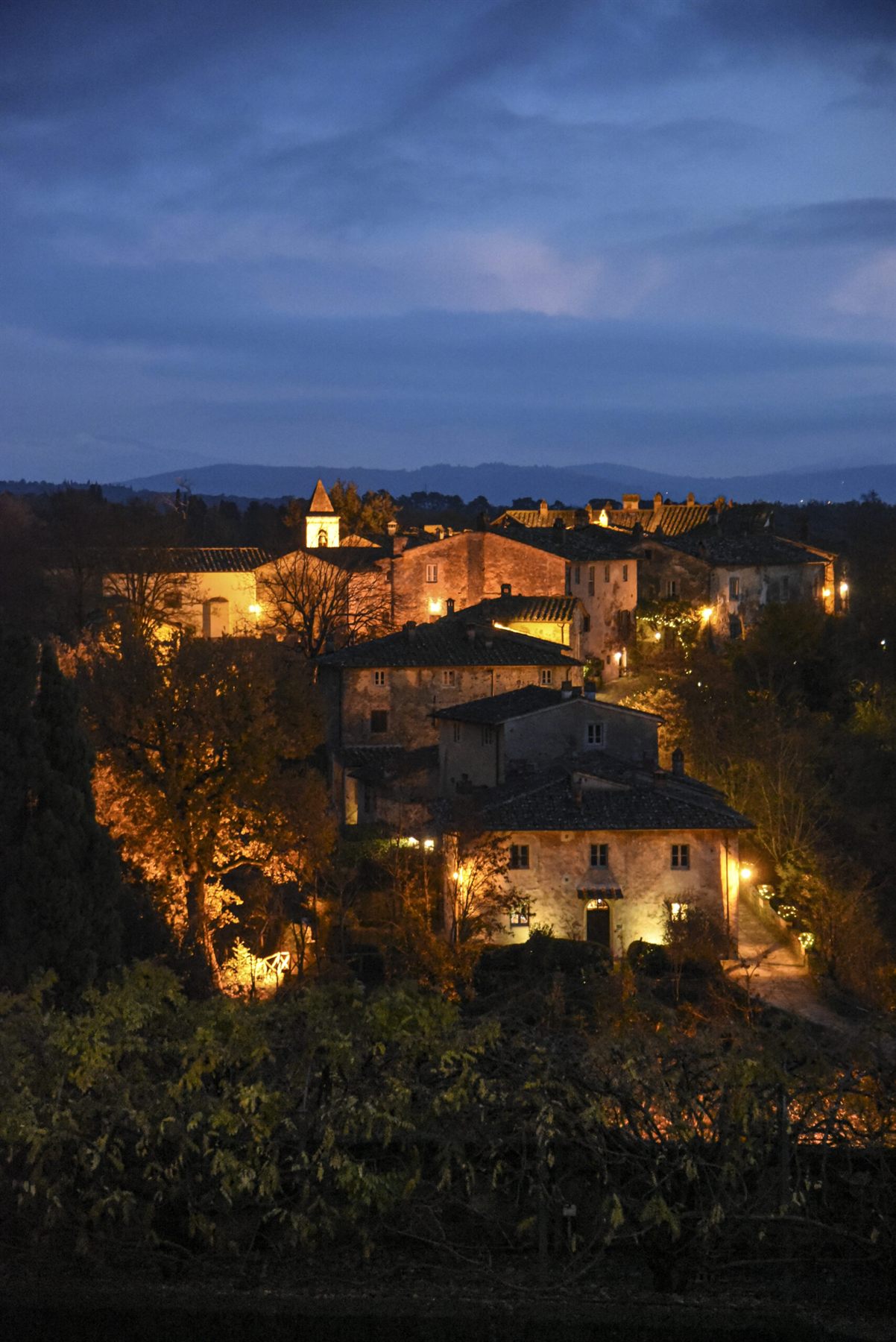
Il Borro is an eleventh-century farming hamlet in the municipality of San Giustino Valdarno, a few minutes' drive from Laterina. For centuries it was a small settlement of sharecroppers tied to the estate surrounding it; today the property belongs to the Ferragamo family, who restored the farmhouses and turned them into a scattered resort while preserving the original layout: cobbled lanes, the clock tower, a small church, the old farmers' houses arranged around the central square. The estate covers roughly seven hundred hectares of vineyards, olive groves and woodland, producing wine, including the Il Borro-branded Tuscan IGT, and extra virgin olive oil. It isn't an open-air museum: the hamlet is visited on foot among the restored houses, and on summer evenings it comes alive with warm light, best seen arriving at dusk, when the stone façades light up one by one along the hillside. It's a good example of how, in the Valdarno, farming and hospitality have intertwined without upending the landscape: the surrounding hills are still planted with vines and olives as they were centuries ago, and the hamlet has kept the proportions of a rural settlement rather than those of a tourist village built from scratch. For guests staying in Laterina, Il Borro is the shortest possible excursion: a few minutes by car take you from the walls of a medieval castle to an equally old hamlet, but one reshaped into a contemporary hospitality project, a direct contrast between two different ways of inhabiting the same land. Nearby there are short paths for walks among the vineyards, with views over the Valdarno opening up as the ground rises, and a small museum recounting the estate's agricultural history. The visit pairs easily with Loro Ciuffenna, a medieval village with an old mill on the Ciuffenna stream and a historic centre perched on the rock, a few kilometres away: a half-day that touches two very different realities while staying in the same corner of the Valdarno.
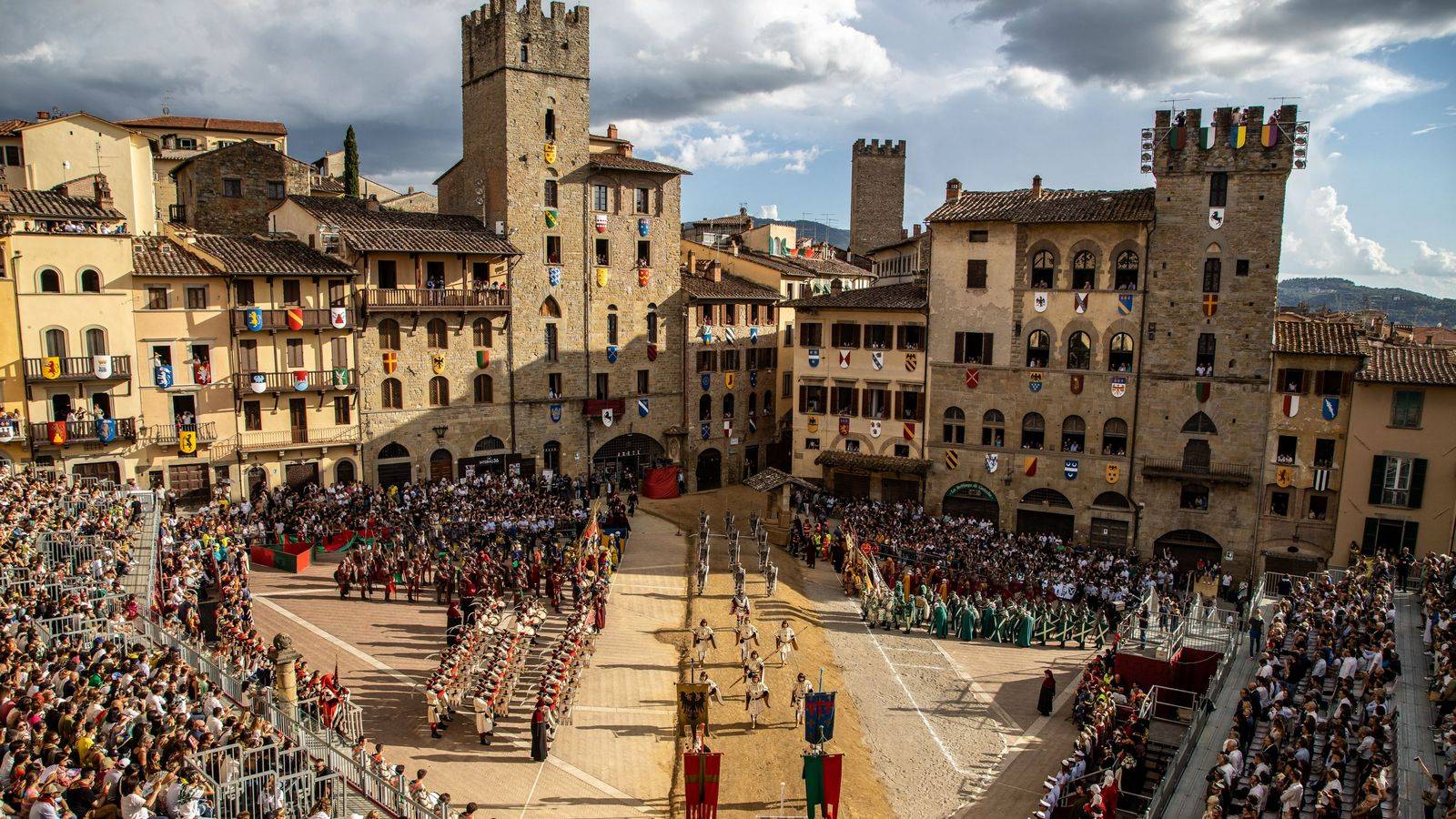
Arezzo is the nearest city of any size to Laterina, reachable in under twenty minutes by car. The heart of the city is Piazza Grande, a steeply sloping square ringed by medieval and Renaissance palaces, including the apse of the Pieve di Santa Maria and loggias designed by Giorgio Vasari, who was born in Arezzo. It's here that, every year on the first Sunday of September and on the Saturday before the penultimate weekend of June, the Giostra del Saracino takes place: eight armoured knights, one for each city quarter, charge at full speed at a dummy representing King Buratto, trying to strike its shield without being unhorsed by the mace that the spinning figure swings back at them. It's one of Italy's best-preserved historic jousts, documented as far back as the sixteenth century. A short walk from the square stands the Basilica of San Francesco, home to Piero della Francesca's fresco cycle The Legend of the True Cross, one of the most important pictorial cycles of the early Italian Renaissance. Arezzo is also a city of Etruscan and Roman foundation, later a free medieval commune often at odds with Florence and Siena, before falling under Florentine rule in the fourteenth century: the walls, the surviving towers and the irregular layout of the old town's streets still carry the marks of this layered history. The city is today an important centre of goldsmithing, a tradition dating back to the twentieth century that now employs thousands of people in the area. For guests staying in Laterina, Arezzo is the natural base for everyday shopping and services, and sits on the Rome–Florence railway line, but it also deserves a visit in its own right: a couple of hours for the historic centre, with time to extend the stop for lunch at one of the trattorias around Piazza Grande, or to climb up to the Medici Fortress for a view that sweeps across the whole surrounding valley, Laterina included.
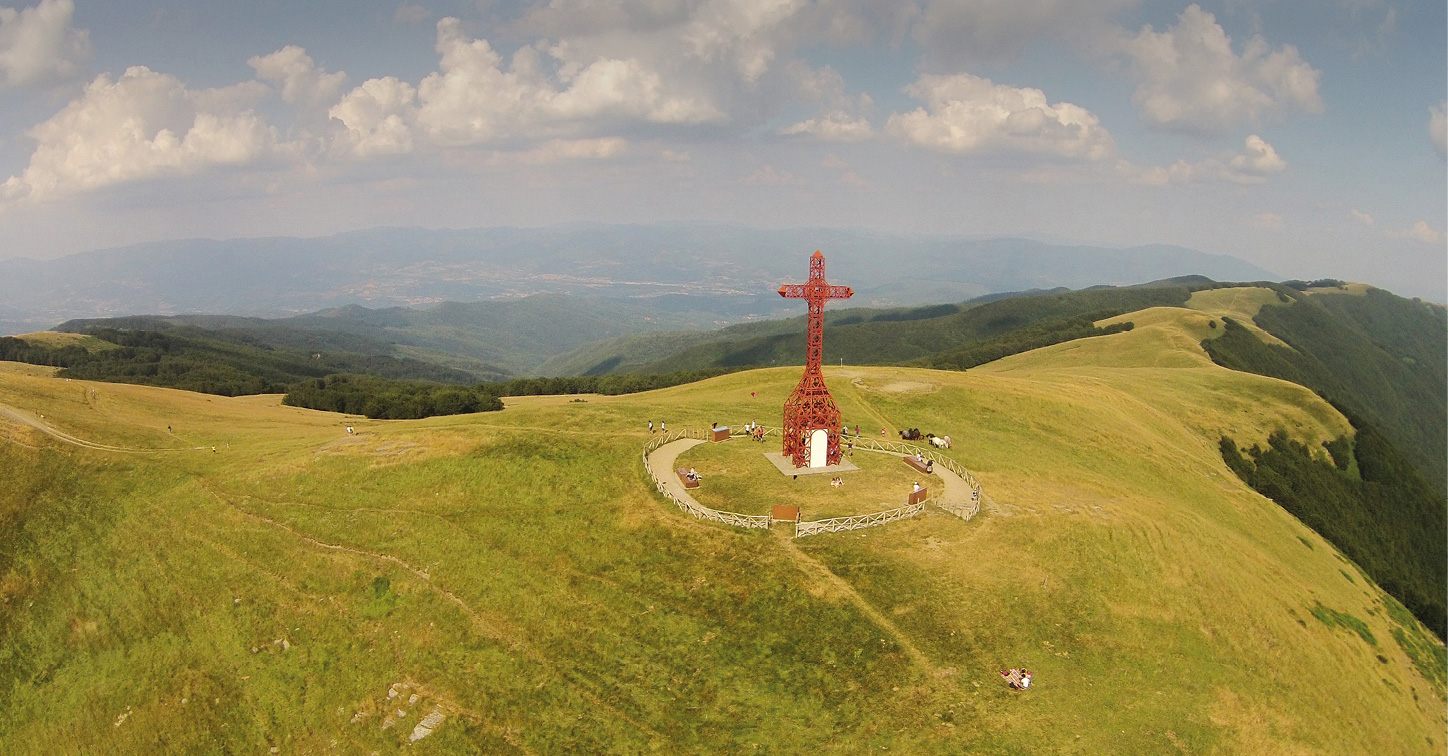
The Pratomagno is the mountain massif that closes off the Valdarno on its north-eastern side, visible from many windows in Laterina on clear days. It's a long ridge rising above thirteen hundred metres, covered with beech and chestnut woods lower down and, higher up, with the broad upland pastures known as "prati" that give the range its name. The crest can be walked almost entirely along a ridge path marked by the Italian Alpine Club, with views alternating between the Valdarno on one side and the Casentino on the other: on the clearest days the eye reaches as far as the Apennines and, to the south, the hills of Chianti. Its best-known and most photographed spot is the Croce del Pratomagno, a large wrought-iron cross erected in 1928 on the summit that shares its name, today the goal of both short walks and multi-day hikes along the full ridge. It's a destination aimed above all at those seeking proper trekking: the paths are well marked and suited to different levels of fitness, from a few hours' walk starting at passes reachable by car to the full traverse of the ridge over two or three stages, with mountain huts and stopping points along the way. In spring the upland pastures fill with wild daffodils, a sight that draws walkers from across the area; in autumn the beech woods turn brilliant colours, and gathering chestnuts remains a common habit in the villages at the foot of the massif. At the base of the Pratomagno, on the Valdarno side, lie villages such as Loro Ciuffenna and Castelfranco di Sopra, convenient starting points for those who want to take on the trails without straying far from Laterina. For guests staying at the castle, the Pratomagno is the ideal outing for a day outdoors: twenty minutes by car are enough to leave the medieval walls behind and find yourself immersed in green, with the choice between a short walk to a viewpoint or a more demanding hike up to the summit cross.
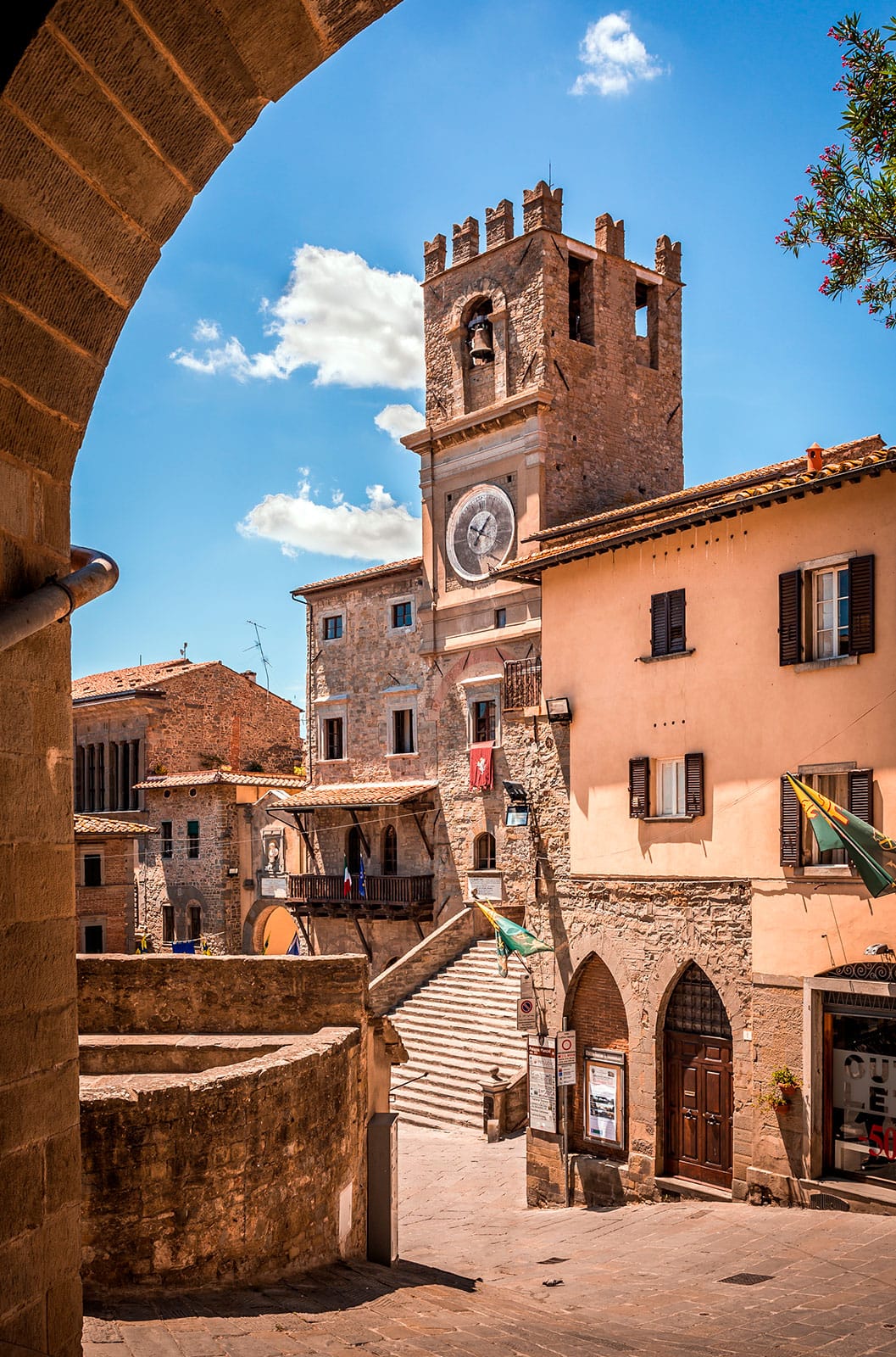
Cortona is an Etruscan city, later Roman and medieval, perched on a spur of Monte Sant'Egidio overlooking the Val di Chiana, about three quarters of an hour by car from Laterina. Its origins predate Rome by centuries: the Etruscan walls of squared stone blocks, still visible in part along the city's perimeter, and the monumental tombs in the surrounding countryside, such as the Melone del Sodo, testify to Cortona's importance as one of the twelve centres of the Etruscan League. The heart of the medieval city is Piazza della Repubblica, dominated by the Palazzo Comunale with its staircase and civic tower, while Piazza Signorelli houses the Museo dell'Accademia Etrusca, gathering artefacts from the Etruscan age to the nineteenth century, including a celebrated Etruscan bronze chandelier from the fifth century BC. The steep, cobbled streets of the centre climb up to the Medici fortress of Girifalco, from which the view stretches, on the clearest days, as far as Lake Trasimeno in Umbria. Cortona is also linked to the painter Luca Signorelli, born in the city, and to Fra Angelico, who lived there as a Dominican friar. In recent decades the city has gained international fame thanks to the book and film Under the Tuscan Sun, set precisely in Cortona and the surrounding countryside. A few kilometres from Cortona, along the road back toward Arezzo, lies Castiglion Fiorentino, a lesser-known but equally worthwhile village, with a Vasari-designed loggia overlooking the main square and a historic centre that has kept its medieval layout almost intact: a stop that can easily be added to a visit to Cortona for those with a full day to spare. From Laterina, the Val di Chiana with Cortona and Castiglion Fiorentino makes for one of the most complete outings: landscape, Etruscan and medieval history, and a local cuisine that sets the standard for the whole area.
The Casentino is the upper Arno valley, upstream from Arezzo, a more mountainous and wooded territory than the Valdarno, closed to the east by the Apennine ridge and to the west by the Pratomagno. Its natural heart is the Casentino Forests, Monte Falterona and Campigna National Park, which protects one of the most extensive beech forests in the northern Apennines, with centuries-old trees that in some spots have never been felled by human hand. The Sasso Fratino integral reserve within the park is so well preserved that, since 2017, it has been included among the Italian sites in the UNESCO network dedicated to Europe's ancient primary beech forests, a recognition shared with very few other forests on the continent that remain in a genuinely natural state. It's an ideal destination for those seeking trekking and excursions immersed in largely unspoiled nature: the park's trail network is extensive and well marked, with routes ranging from short family walks to multi-day traverses along the Apennine ridge, often with the chance to spot deer, roe deer and, with a bit of luck, the wolf, which has returned to these woods steadily over the past few decades. Autumn is the most spectacular season to visit the Casentino: the foliage, the colour change of beech, chestnut and maple leaves that tints the woods red, orange and gold, draws walkers and photographers from across the region, especially in the weeks between late October and mid-November. Beyond its nature, the Casentino also holds villages and sites of historical importance, such as Poppi, with its Conti Guidi castle overlooking the valley, and Bibbiena, the area's main town. It's reached from Laterina in about three quarters of an hour by car, heading up the Arno valley: an outing well suited to those who, after visiting villages and art cities, are looking for a day immersed in green, among woodland paths, with a real chance of seeing one of Italy's best-preserved forests.
Chianti is the hill country between Florence and Siena that has become, around the world, synonymous with the Tuscan agricultural landscape: rows of vines running across the hillsides, olive groves, cypresses lining the drives up to farmhouses, walled villages crowning the hilltops. Mercatale, a hamlet of San Casciano in Val di Pesa, was chosen as the reference point for the map, in the heart of the Florentine Chianti: from there, white gravel roads branch out in every direction through the area's wine estates, many of which are open for visits and tastings. The name Chianti is above all tied to wine: Chianti Classico, recognisable by its black rooster emblem, is produced under regulations governing the zones of origin, the permitted grape varieties, mainly Sangiovese, and the minimum ageing periods. The area's cellars range from large historic estates to small family-run producers, and many organise visits to the vineyards and winemaking cellars, often paired with lunch or a guided tasting. Beyond wine, the Chianti landscape is also protected by law: much of the territory falls under a landscape conservation zone that regulates new building precisely to preserve the historic appearance of the hills. The area's villages, such as Greve in Chianti, Castellina in Chianti, Radda in Chianti and Panzano, retain small-scale medieval centres, often built around an arcaded square where the weekly market is still held. From Laterina, Chianti is about three quarters of an hour away by car, crossing the Valdarno and the hills that separate the Arno valley from that of the Pesa. It's an outing well suited to a full day, perhaps pairing a morning cellar visit with an afternoon walk through one of the walled villages, before heading back to Laterina in the evening.
The Hermitage of Camaldoli stands in the heart of the Casentino Forests, a short distance from the better-known Monastery of Camaldoli, founded according to tradition by Saint Romuald around the year 1012. Though close together, the two sites serve different, distinct purposes: the Monastery, lower down and more accessible, still hosts a community of Camaldolese monks today, along with a historic pharmacy open to the public since the sixteenth century and an old guesthouse; the Hermitage, perched higher up within the dense forest at around one thousand and one metres, is instead the original and more austere core of the community, made up of small independent cells arranged around the church, each with its own small garden, where the monks live under a regime of partial isolation and silence that recalls the eremitic origins of the Camaldolese Benedictine order. The Hermitage church, richly decorated in Baroque style, deliberately contrasts with the austerity of the surrounding cells, and remains open to visitors during daytime hours along with a small portion of the complex, while the monks' actual enclosure remains reserved to them. The forest surrounding the Hermitage is part of the same protected woodland of the Casentino Forests National Park, with centuries-old beech woods that in autumn offer the same intense colours that make the area's foliage famous. The path climbing from the Monastery to the Hermitage, walkable in about forty minutes through the woods, is one of the most direct ways to grasp the logic of the place: a physical and symbolic journey from the community life of the monastery toward the more radical silence of the hermitage. Camaldoli draws both religious visitors, for its historical importance in Benedictine and Camaldolese spirituality, and simple hikers drawn by the natural setting. It's reached from Laterina in about an hour by car, heading up into the Casentino: an outing that combines a visit to a place of silence and reflection with a walk in the woods, and pairs well, on the same day, with a broader stop in the Casentino Forests National Park.
Anghiari is a walled village in the Valtiberina, perched on a hill a few kilometres from Sansepolcro, along the same valley marking the border with Umbria, about three quarters of an hour by car from Laterina. It's listed among Italy's Most Beautiful Villages, and it takes only a walk along its narrow cobbled streets, squeezed between stone houses, its steep alleys and its almost intact thirteenth-century walls, to see why. The town's name is tied above all to a battle: on 29 June 1440, in the plain below the village, troops of the Florentine Republic defeated the army of the Duchy of Milan, an event that consolidated Florence's expansion into eastern Tuscany. Nearly a century later, in 1503, Leonardo da Vinci was commissioned to paint that very battle on a wall of the Salone dei Cinquecento in Florence's Palazzo Vecchio: the Battle of Anghiari, which, according to contemporary accounts, depicted the clash between horsemen fighting over a standard with unprecedented violence. The work was never finished, and the mural, damaged by an experimental painting technique Leonardo himself had devised, was later lost, perhaps painted over during a subsequent intervention by Giorgio Vasari: its fate remains one of art history's great mysteries, still the subject of research and speculation, some of which holds that the original fresco survives hidden beneath the current Vasari frescoes. Only copies and preparatory drawings survive of the painting, including the well-known copy by Rubens now in the Louvre. In Anghiari, the State Museum at Palazzo Taglieschi holds works of sacred art, while the upper part of the village, around Piazza del Popolo, keeps the atmosphere of a medieval centre that has remained surprisingly authentic. From the walls, a wide view opens over the Valtiberina, with the Tiber running through the plain below, still a young river only a few kilometres from its Apennine source. For guests staying in Laterina, Anghiari is easily visited in a couple of hours, and pairs naturally with Sansepolcro, a handful of kilometres away along the same road.
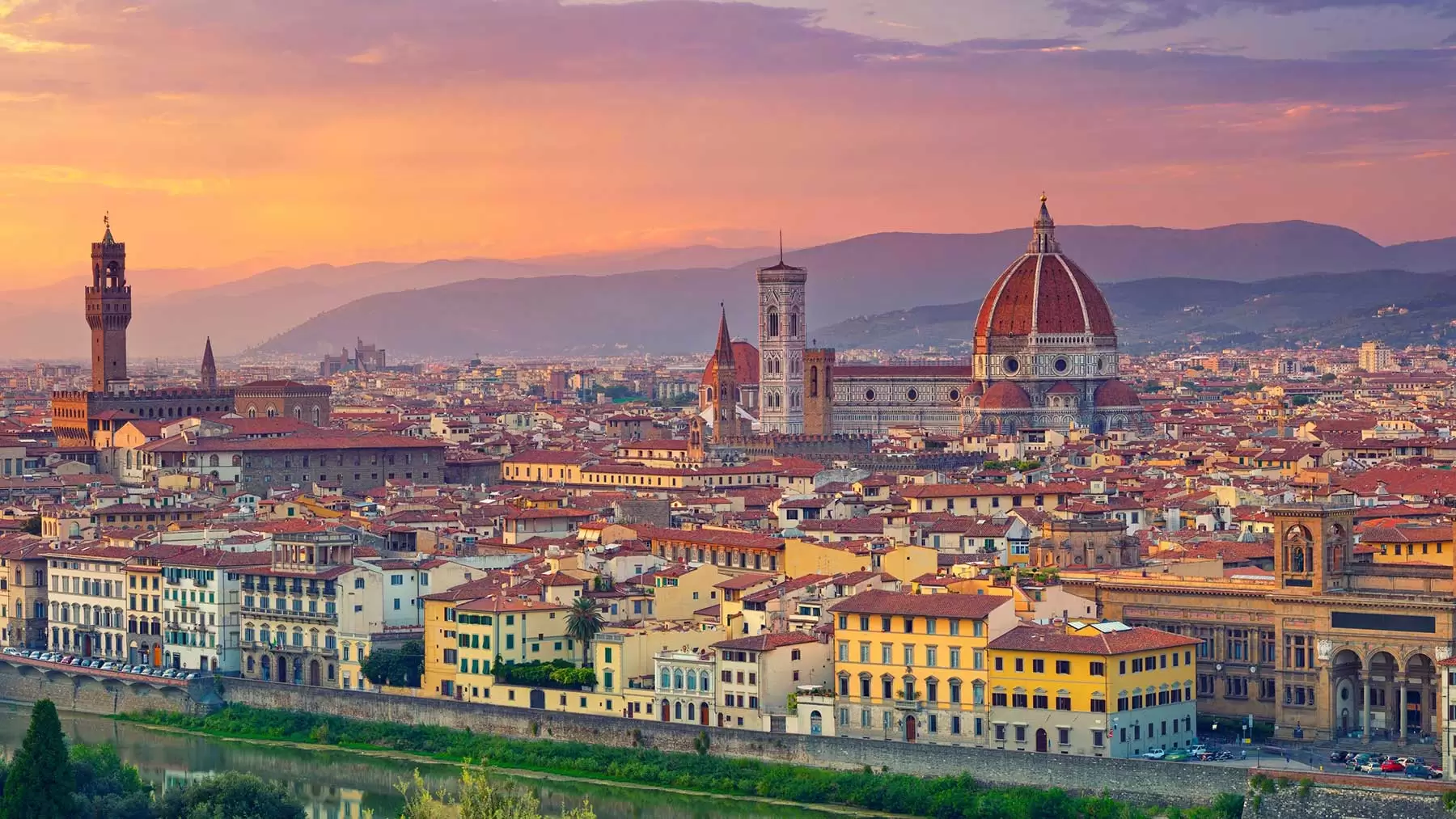
Florence is the city that gave the Renaissance its shape, and it's about an hour from Laterina, whether by car along the A1 motorway or by train from Montevarchi or Arezzo station. Its historic centre has been on the UNESCO World Heritage list since 1982, recognised as an urban ensemble of exceptional value in which architecture, art and civic history developed together over several centuries. The city's symbol is the dome of Santa Maria del Fiore, designed by Filippo Brunelleschi and completed in 1436 without wooden centring, using a double-shell technique and herringbone brickwork that had no precedent at the time: it remains the largest masonry dome ever built. Beside the cathedral stand Giotto's bell tower and the Baptistery of San Giovanni, with Ghiberti's bronze doors that Michelangelo, according to tradition, called worthy of being the Gates of Paradise. A little further south, Piazza della Signoria was for centuries the city's political centre, dominated by Palazzo Vecchio, seat of Florentine government since the fourteenth century, and connected to the Uffizi Gallery, which holds one of the most important painting collections in the world: Botticelli's Birth of Venus and Primavera, Leonardo's Annunciation, Michelangelo's Doni Tondo, works by Giotto, Piero della Francesca, Titian and Caravaggio. Michelangelo's David, meanwhile, is at the Galleria dell'Accademia, where it was moved in 1873 to protect it from the weather. On the Arno, the Ponte Vecchio still carries the goldsmiths' workshops that have lined it since the sixteenth century, when Ferdinando I de' Medici replaced the butchers there for reasons of decorum, and it's the only Florentine bridge to survive the bombing of 1944. Across the river lie the Oltrarno district with Palazzo Pitti and the Boboli Gardens, and the climb up to Piazzale Michelangelo, from which the city's entire skyline can be taken in at a glance. For guests staying in Laterina, Florence is the most accessible of the great art cities: it deserves at least a full day, and it's worth booking the Uffizi and the Accademia well in advance, as they sell out weeks ahead in high season.
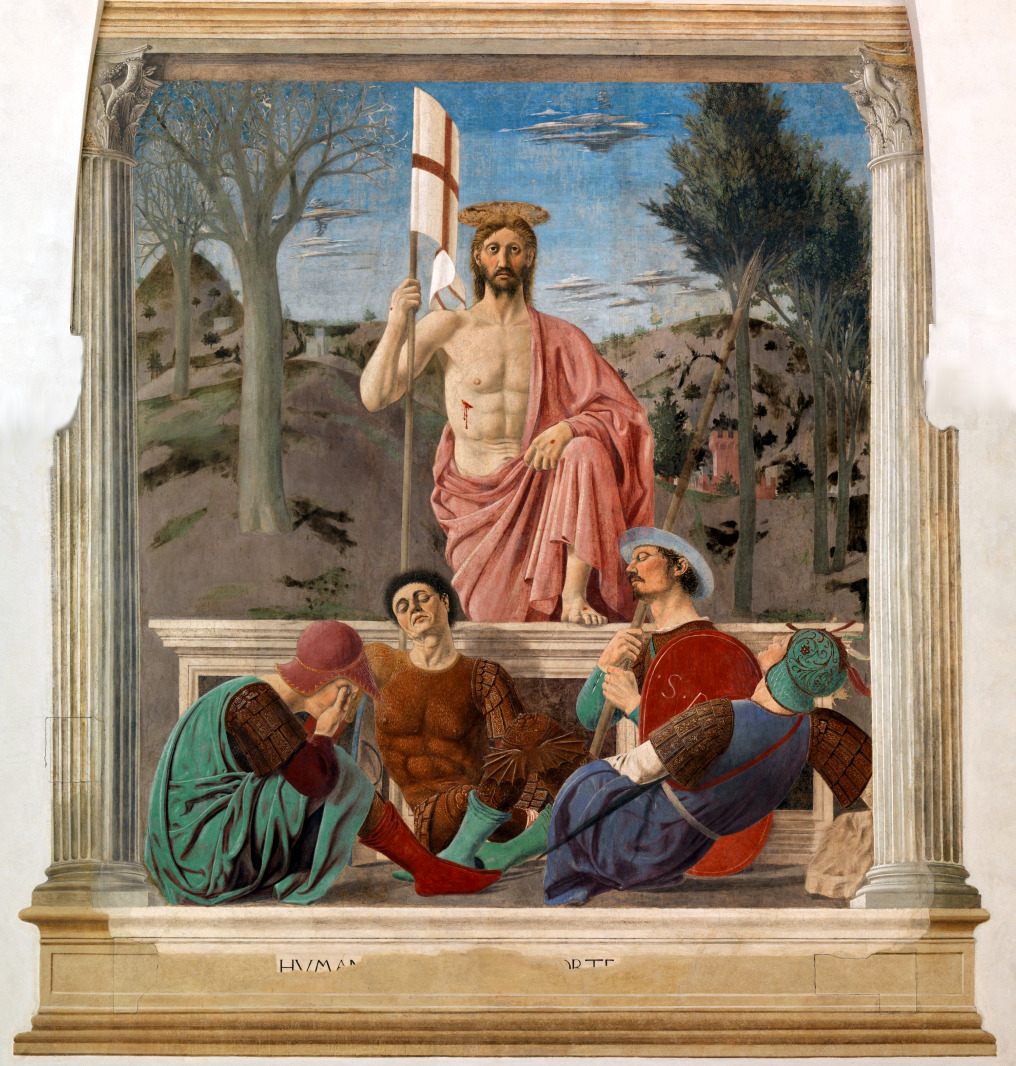
Sansepolcro lies in the Valtiberina, at the easternmost edge of the province of Arezzo, close to the border with Umbria, about three quarters of an hour by car from Laterina. According to tradition, the town owes its name to two pilgrims returning from Jerusalem who, in the tenth century, brought relics of the Holy Sepulchre here and founded a small oratory around which the settlement grew. But the city's fame rests above all on a single name: Piero della Francesca, painter and mathematician born here around 1415, one of the central figures of the early Italian Renaissance. The Museo Civico, housed in the former Palazzo della Residenza, holds his most celebrated fresco, the Resurrection: Christ rising from the tomb with a fixed, unwavering gaze, while the soldiers on guard sleep unaware at his feet. The English writer Aldous Huxley, in a 1925 essay, called it “the best picture in the world”, and the phrase has stuck to the work ever since. The same museum also holds the Polyptych of the Misericordia, another work by Piero della Francesca, made for the town's confraternity over the course of fifteen years. The historic centre, enclosed by largely intact medieval walls, has kept an urban layout essentially unchanged since the fifteenth century: the Palazzo delle Laudi, the Renaissance town hall, the Cathedral of San Giovanni Evangelista with its Romanesque crypt, and narrow streets lined with stone palaces that speak of a city that, in the Renaissance, was a leading artistic and mercantile centre before falling under Florentine rule in 1441. Sansepolcro is also the birthplace of Buitoni pasta, founded here in the nineteenth century, and every second Sunday of September it hosts the Palio della Balestra, a crossbow contest against its historic rival Gubbio, in Umbria, a tradition handed down since the fifteenth century amid flag-throwers and costumed processions. For guests staying in Laterina, Sansepolcro is an outing best suited to lovers of early Renaissance art: a good hour is enough for the Museo Civico and a walk through the old town, but the visit easily stretches to a full day when paired with nearby Anghiari, a few kilometres down the same valley.
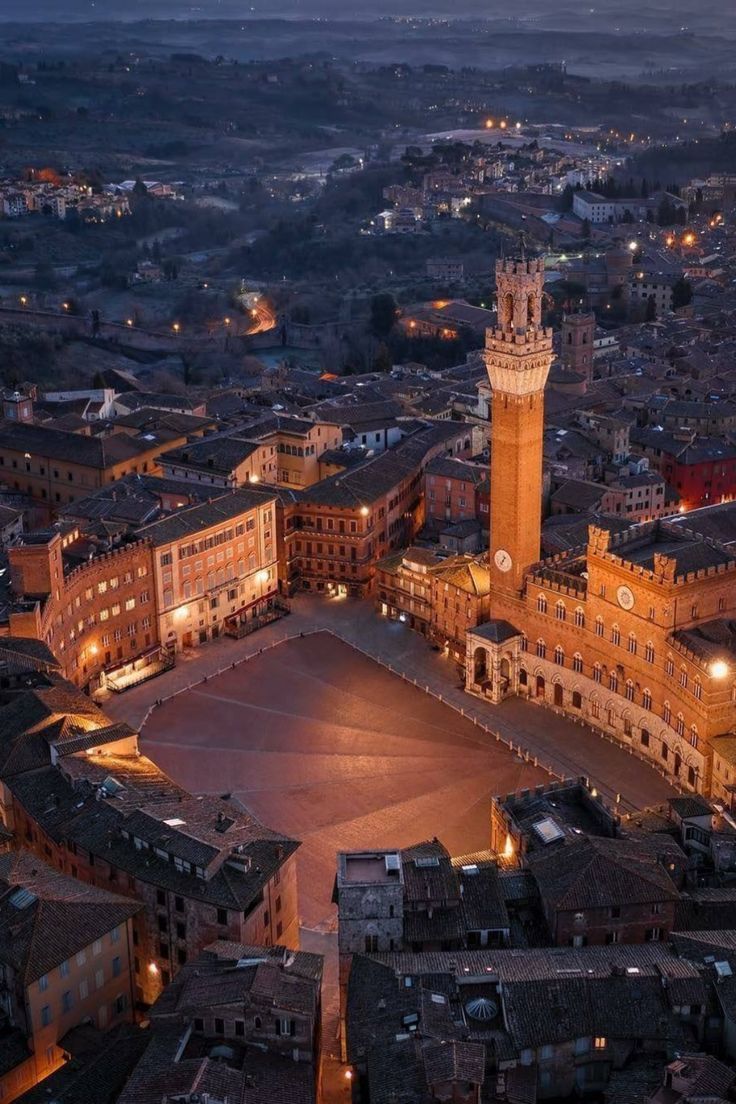
Siena is one of Tuscany's best-known art cities, about an hour's drive from Laterina through the hills of eastern Chianti. Its historic centre, declared a UNESCO World Heritage Site in 1995, preserves an almost intact medieval layout, built in the ochre-coloured brick that gives the colour "burnt sienna" its name. The heart of the city is Piazza del Campo, one of Europe's best-preserved medieval squares, shell-shaped and divided into nine sections recalling the Government of the Nine that ruled the city in the fourteenth century. Facing the square is the Palazzo Pubblico with the Torre del Mangia, over eighty-seven metres tall, which can be climbed for a view over the city's rooftops and the surrounding countryside. Twice a year, on 2 July and 16 August, the square becomes the arena for the Palio di Siena, a bareback horse race between the city's seventeen contrade that lasts around ninety seconds but is preceded by days of ceremonies, trials and historic costumed processions: probably the most deeply felt identity event in all of Tuscany. A short walk from the Campo stands Siena's Duomo, one of the finest expressions of Italian Gothic, with a façade of white, green and pink marble and a floor entirely inlaid with biblical scenes, created over almost two centuries by dozens of different artists. The city was for centuries Florence's rival, contesting supremacy over central Tuscany until its defeat at the Battle of Marciano in 1554, which marked the beginning of its political decline but not of its artistic and cultural one. From Laterina, Siena is the most demanding city outing on offer, but also one of the most complete: a full day allows time for the Duomo, Piazza del Campo and some of the smaller museums, while still leaving room to get lost among the contrade of the old town.
San Gimignano is one of Tuscany's most recognisable medieval villages, in the Val d'Elsa, in the province of Siena, about an hour and a quarter by car from Laterina via Siena and Poggibonsi. Its skyline, visible from miles away, is made of towers: in the Middle Ages the town's noble families built as many as seventy-two of them, symbols of power and prestige more than defensive structures, each family competing to build the tallest. Fourteen survive today, but they're enough to make the town's profile unique in Italy, earning it the nickname “the Manhattan of the Middle Ages” for a vertical skyline that anticipates skyscrapers by centuries. The historic centre, declared a UNESCO World Heritage Site in 1990, gathers around Piazza della Cisterna, paved in a herringbone pattern and centred on an old fourteenth-century well, and around Piazza del Duomo, home to the Collegiata, with a fresco cycle narrating the Old and New Testaments by artists such as Bartolo di Fredi and Taddeo di Bartolo, alongside the Chapel of Santa Fina, frescoed by Domenico Ghirlandaio. The Torre Grossa, the tallest of the surviving towers at fifty-four metres, is the only one open to climb: from the top, the view sweeps over the vineyards of the Val d'Elsa and, on the clearest days, as far as the hills of Chianti. San Gimignano is also home to Vernaccia, the first Italian wine to receive a controlled designation of origin, in 1966, and among the first to reach DOCG status, in 1993: a dry white grown on these hills since the Middle Ages, when it was already mentioned by Dante in the Divine Comedy. The narrow, cobbled streets of the centre are today lined with craft workshops and wine bars, but in the early morning, before the tour groups arrive, it's still possible to feel the atmosphere of a quiet medieval village, its towers cutting against the sky. For guests staying in Laterina, San Gimignano is an outing worth planning around timing rather than distance: it's best to arrive early or in the late afternoon, perhaps pairing the visit with a stop in Siena, which lies along the same route.
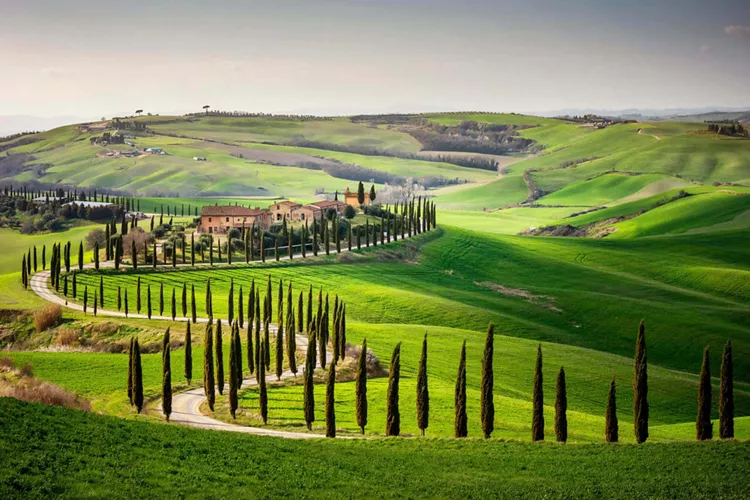
The Val d'Orcia is the hill valley opening up south of Siena, recognised by UNESCO as a World Heritage Site in 2004 for the exceptional quality of its agricultural landscape, largely unchanged since the Renaissance. It's the landscape that appears in Tuscany's most reproduced photographs: gentle hills covered in wheat and sunflowers, rows of cypresses along white gravel roads, isolated farmhouses crowning the hilltops, as in the famous image of the road climbing toward the Poderina farm near San Quirico d'Orcia. The valley takes its name from the Orcia river, which runs through it from north to south, and includes villages such as Pienza, redesigned in the fifteenth century by Pope Pius II Piccolomini according to the principles of Renaissance town planning, so much so that it's considered the first ideal city ever realised; San Quirico d'Orcia, with its Renaissance Horti Leonini gardens; and Bagno Vignoni, where the village's central square is occupied by a large rectangular thermal pool of medieval origin, fed by natural hot springs. Closing the valley to the south-west is Montalcino, a fortified village dominated by its fourteenth-century fortress, famous worldwide as the home of Brunello di Montalcino, a red wine made exclusively from Sangiovese Grosso grapes and subject to a long mandatory ageing period before release, making it one of Italy's most sought-after and expensive wines. The hills around Montalcino are covered in vineyards alternating with oak woods, and the area's cellars are largely open to visits by appointment. From Laterina, the Val d'Orcia and Montalcino make for the furthest outing on offer, nearly two hours by car, but also the one that most immediately delivers the image of Tuscany most travellers carry with them even before setting off: for that reason it's worth setting aside a full day, perhaps planning the stops from north to south, from San Quirico to Pienza and on to Montalcino, ending with a cellar visit before heading back.
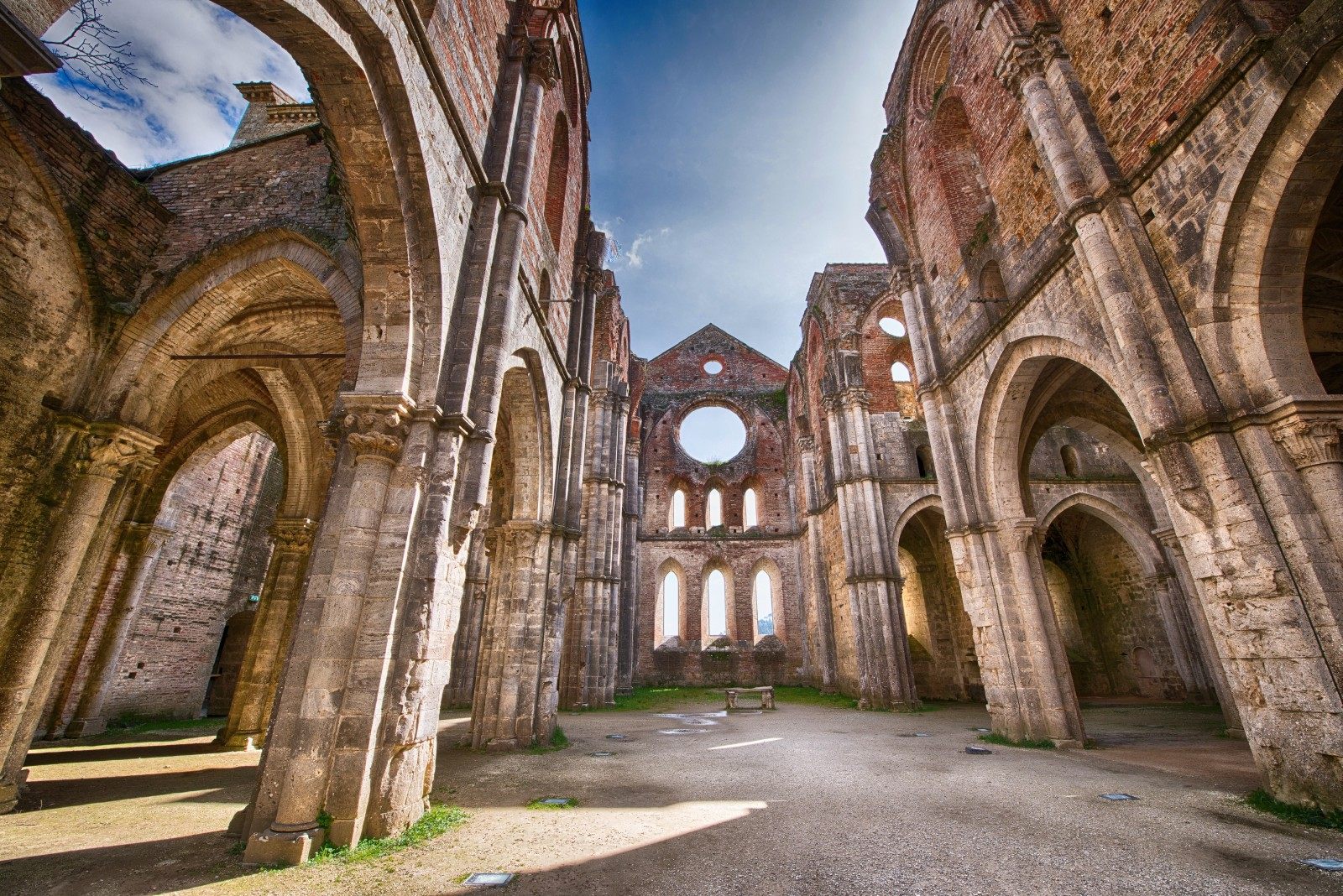
The Abbey of San Galgano stands alone in open countryside in the municipality of Chiusdino, in the province of Siena, about an hour and a half by car from Laterina. It's one of the most photographed images of rural Tuscany: a great Cistercian Gothic church with no roof left, its pointed arches open to the sky, grass where the floor used to be, growing where monks once knelt. It was built starting in 1224 on the model of the great French Cistercian abbeys, with influences also recognisable in the architecture of Siena's Cathedral, built shortly after. The order, which for a long time prospered by controlling vast agricultural estates, fell into decline between the fourteenth and fifteenth centuries, hit by epidemics, raids and an economic crisis that gradually emptied the monastery; in the eighteenth century the roof, by then long unmaintained, collapsed along with the bell tower, leaving the structure in the striking open-air ruin seen today. A short distance away, on a grassy hillock, stands the Hermitage of Montesiepi, a circular building older than the abbey itself, built on the spot where, according to legend, the knight Galgano Guidotti, after a life of violence, thrust his sword into a rock in 1180 as a gesture of renouncing arms, before retiring into hermitage until his death. The sword, or what remains of it, is still visible today, embedded in the stone at the centre of the small chapel: an image that has fed comparisons, never proven but often drawn, with the Arthurian legend of the sword in the stone, which followed shortly after. The walls of the Rotonda di Montesiepi also preserve a fourteenth-century fresco cycle attributed to Ambrogio Lorenzetti, including a rare Maestà. San Galgano was canonised only a few years after his death, among the first saints in Church history to receive a formally documented canonisation. Today the deconsecrated, roofless abbey occasionally hosts concerts and cultural events. For guests staying in Laterina, San Galgano is the furthest outing on offer: it's worth setting aside half a day, perhaps combining it with a stop in Siena, about forty minutes away.
Distances are approximate, calculated by car from the centre of Laterina.